

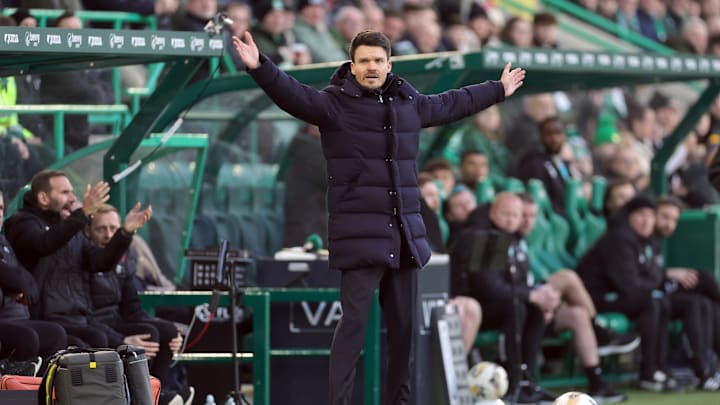
The noise around Rangers rarely needs much encouragement, and a 0–0 draw away to Hibernian at Easter Road was always going to provoke a reaction.
With Rangers now once again third in the Scottish Premiership table, behind Celtic on goal difference and six points off leaders Hearts, it has been enough for some sections of the support to turn on Danny Rohl, branding the German head coach a “yes man” and framing the club’s league position as proof he is part of the problem rather than the solution.
That reading doesn’t stand up to even a basic look at what Rangers were when he arrived, what he inherited, and what has actually changed since he took over.
When Rangers were under Russell Martin, the side went seven matches without building anything resembling momentum.
The team’s results were not simply below the standard required to win a title; they were fundamentally incompatible with a club expecting to control games, impose rhythm and turn pressure into points.
Over that seven-game spell, Rangers won once, drew five times and lost once, which works out at 1.14 points per game. Even before you get to the optics, the injuries or the explanations, that figure tells you everything: a title-winning pace is typically built on two points per game or more, and Rangers were operating way below that baseline.
It also wasn’t just about results. Rangers scored six goals across those seven games, an average of 0.86 goals per game, and conceded seven, exactly 1.00 conceded per game.
For a club built around front-foot football, those numbers are a double warning light: not enough threat to force wins, not enough control to protect leads or turn narrow games decisively in your favour.
Then came the single-game interim spell under Stevie Smith, which ended in a draw. That match added two goals scored and two conceded, leaving the combined eight-game period at one win, six draws and one defeat, with an overall return of 1.13 points per game, exactly 1.00 goals scored per game and 1.13 conceded per game.
That is mid-table form, not a foundation for a team chasing a league title.
Now place that alongside what has happened under Danny Rohl. In 16 matches in charge, Rangers have won 12, drawn three and lost once, the only defeat coming at Tynecastle.
That is 39 points from 16 games, a points-per-game rate of 2.44. Put simply, the difference between 1.13 and 2.44 is the difference between drifting and competing. It isn’t marginal improvement; it is a complete change in trajectory.
The same is true in both boxes. Under Rohl, Rangers have scored 29 goals in 16 matches, which is 1.81 goals per game, and conceded eight, which is 0.50 conceded per game.
That is the profile of a side that is far more likely to win than not, because it is creating enough to tilt probability and defending well enough to avoid self-inflicted damage. The jump from 1.00 goals per game in the Martin/Smith stretch to 1.81 under Rohl is significant; so is the drop from 1.13 conceded per game to 0.50.
Those are not the numbers of a coach riding his luck or being carried by moments. They are the numbers of a team that has become harder to beat and more capable of building repeatable wins.
This matters because it reframes the Easter Road draw properly. The frustration is understandable: Rangers did not create enough, and they did not land the kind of decisive blow you need in a tight title race.
But treating a single 0–0 as a referendum on the manager, while ignoring the wider pattern of results and performance metrics since he arrived, is exactly the sort of emotional over-correction that creates chaos rather than clarity.
Rohl’s own words after the match captured the essence of what has changed: he is focused on consistency and process, not spiralling into self-sabotage after one setback.
The “yes man” label is even more flimsy when you look at how Rangers structure has shifted since his appointment. Within a month of arriving, Rohl’s internal review to the Ibrox ownership contributed to the departures of CEO Patrick Stewart and sporting director Kevin Thelwell.
That is not what happens around a passive figurehead whose job is to nod along and absorb blame. That is what happens when a head coach has enough influence, trust and authority to shape the direction above him.
Rangers have also leaned heavily on Rohl in January recruitment planning alongside interim footballing consultant Stig Inge Bjornebye. Again, that is a sign of control, not compliance.
You can see it in squad management too. If Rohl was merely there to protect reputations or polish prior decisions, he would have been expected to squeeze output from every “investment” regardless of fit.
Instead, he has overseen the (incoming) shifting of Joe Rothwell and Lyall Cameron, both summer signings, decisions that clubs do not typically sanction unless the head coach’s judgement is being prioritised over sunk-cost thinking.
Moving on from players quickly is rarely popular internally, but it is often necessary when a manager is trying to rebuild a functional squad in real time.
And then there’s the most obvious point of all: Rangers have improved despite the forward line not consistently firing. All three recognised strikers have had periods where the goals have not matched the volume of possession or territory Rangers often enjoy.
Yet Rohl has still built a higher scoring rate, which tells you the team’s attacking structure is functioning better, with more players contributing and more chances arriving from repeatable patterns rather than hope.
Within that, Yousef Chermiti is the clearest example of coaching impact. Even if his goal return remains a work in progress, his all-round game has improved sharply: his effort, his hold-up play, his ability to connect attacks, his contribution to pressing and his willingness to do the ugly work that allows others to shine.
That doesn’t happen by accident, and it doesn’t happen under a coach who isn’t demanding clear standards.
Thelo Aasgaard, seen as a no-hoper under Martin has also managed to improve his game under the former Sheffield Wednesday boss and net some vital goals.
None of this is to pretend Rangers are the finished article. The draw with Hibernian exposed familiar issues: the need for more creativity in the final third, the need to turn control into volume, and the need for sharper decision-making when matches become tight and physical.
It also underlines why Rohl has been pushing for reinforcements, particularly in central midfield, where the injury to Connor Barron has left Rangers short of an experienced number six, and why the club have been active on deadline day looking to recruit Hansa Rostock forward Ryan Naderi.
Rohl has already been backed with signings, with Tuur Rommens, Tochi Chukwuani and Andreas Skov Olsen all recruited earlier this window.
But the lack of a perfect squad is not an indictment of the manager; if anything, the results and metrics suggest he has squeezed significant improvement from a group that was unbalanced and low on confidence when he arrived.
The key point is this: Rangers league position today is not the product of Rohl dragging them down.
It is the product of the damage done before he got the job, and the reality that you can’t undo months of drift overnight without the right tools. What he has done is restore competitiveness, raise performance levels, tighten the defensive base, improve the scoring rate, and give Rangers a genuine chance of sustaining a title chase rather than dreaming about one.
 Add us as a preferred source on Google