

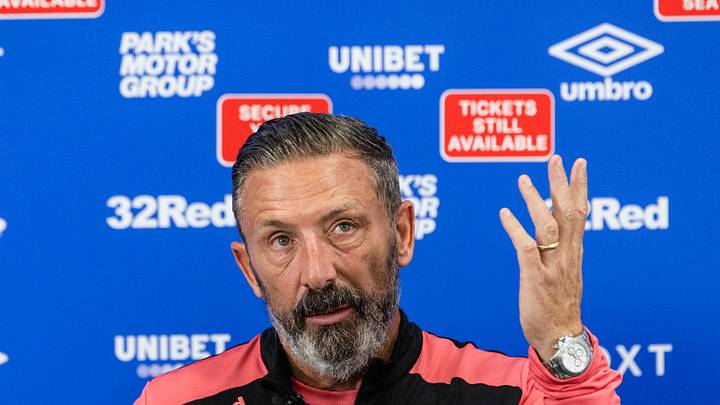
Rangers have found themselves facing another avoidable communications headache, and questions will inevitably be asked of the senior figures responsible for the club’s marketing, communications and digital output.
The latest issue is difficult to miss.
During Derek McInnes’ press conference ahead of the club’s UEFA Europa League second leg tie with Jagiellonia Bialystok, the Rangers manager was filmed against a sponsor backdrop carrying multiple red messages telling supporters: “TICKETS STILL AVAILABLE.”
There is nothing inherently wrong with promoting ticket sales. Rangers need to sell tickets, and commercial inventory needs to be utilised.
But there is a difference between selling tickets and inadvertently advertising empty seats while the club’s manager is speaking to the media.
In the age of social media, a press-conference backdrop is not simply a piece of scenery. Every image and video captured at the media conference can be clipped, posted and viewed by thousands of supporters within minutes, from both supporters of the club and those who despise Rangers as mockery.

Ammo for the enemy
In a period where the Gers are subject to regular mockery for their on-field performances, the last thing the loyal supporters need is more ammunition for their rivals to fire.
That makes the choice of messaging a communications decision as much as a commercial one.
And it puts the spotlight on Rangers’ Chief Communications & Marketing Officer and those below him making these decisions.
Greig Mailer is a senior figure within the club’s leadership structure and has a broad remit covering communications and marketing. Rangers confirmed his involvement in the Scottish Football Marketing Commercial Advisory Board, where he contributes to wider discussions around marketing strategy.
The club said he is “helping to shape the marketing strategy for the game.”
That makes the latest episode all the more curious.
The question is not whether Mailer personally selected the words “Tickets Still Available”. There is no evidence to suggest that he did, and it would be unfair to attribute an individual production decision to him without knowing the internal approval process.
The legitimate question is whether the club’s senior communications and marketing structure has sufficient oversight of how Rangers are presented publicly.
Because this is not the first time supporters have raised concerns about the club's communications.

A wider issue with Rangers’ digital voice
Last season's final Old Firm meeting at Celtic Park generated criticism among sections of the Rangers support over the club's social-media output.
Supporters questioned the decision to publish imagery of Celtic Park in a manner they considered overly positive and, more importantly, pointed to language in some posts which referred to Rangers in the third person, using terms such as “they” and “their” rather than the first-person “we” and “us.”
That may sound like an incredibly small detail. It isn't necessarily so when discussing football-club social media.
The official account is effectively the club's voice. It is not a neutral news agency reporting on Rangers from the outside. The language, imagery and tone are part of the club's identity.
When supporters see an official Rangers account talking about Rangers as though it were an external observer, it can create an impression of detachment.
And when that happens around an Old Firm match, arguably the most emotionally charged fixture in British football, the margin for error becomes even smaller.

Social media malaise
There is another relevant role in the structure: Rangers Head of Digital & Content.
If supporters are unhappy with a social-media post, the question naturally moves towards the digital and content operation. If the concern is the wider communications and marketing strategy, the responsibility moves upwards.
And ultimately, there has to be senior oversight. This is about standards, not one backdrop
It would be excessive to suggest that a ticketing message on a press backdrop represents some major institutional crisis at Rangers.
It doesn't.
But it is precisely the sort of small, avoidable error that a sophisticated communications operation should catch. The same applies to social-media tone.

Why it matters
Rangers are one of the biggest football clubs in Britain. Their official channels are consumed by a huge and highly engaged audience. Every post is scrutinised, particularly when it concerns Celtic supporters.
That means the club needs to understand something fundamental, that Rangers supporters don't consume the club's social media as detached football content. They consume it as the voice of Rangers.
That voice needs to sound like Rangers. It needs to look like Rangers and it needs to understand the environment in which Rangers operates.
The “Tickets Still Available” backdrop may ultimately be nothing more than a marketing asset that nobody thought twice about.
But if nobody thought twice about it, that is precisely the problem.
A club's communications department should be thinking about what every image says before it reaches the public.
The question supporters are entitled to ask is whether that structure is currently exercising enough quality control.
Because when the same concerns begin appearing across different areas, from the tone of Old Firm social-media content to the presentation of the manager in a press conference, it becomes reasonable to ask whether these are isolated mistakes or symptoms of a broader communications problem at Ibrox.
 Add us as a preferred source on Google