

When the 49ers-linked ownership group took control at Rangers, the expectation was competence, clarity, and a modern football structure to finally bring Rangers, so often stuck in the success of the 90’s into the 21st century of football.
Instead, the early months of their reign have produced a catalogue of missteps so glaring they slot neatly into the oldest moral framework of all: The seven deadly sins.
Below, each sin meets its Rangers equivalent under the current leadership.
Pride – Blind faith in a failing appointment
An excessive belief in one's own abilities or an inordinate love of self, considered the sin from which all others arise.
“I’ve been very lucky over the course of my career to work with some very good managers and some very good head coaches and I have to say to you, he’s one of the best.” – Rangers sporting director Kevin Thelwell on Russell Martin.
The regime’s first great act was both bold and bewildering: appointing former Southampton boss Russell Martin as head coach, a man with no track record of winning anything, to a club defined by its demand for trophies.
The second act was objectively worse, taking far too long to sack him, even as the evidence stacked up that the project was a clear and obvious failure.
Rather than course-correct, the hierarchy clung to their decision out of pride, hoping improvement would arrive out of thin air. It never did and eventually their hand was forced, six weeks after a 9-1 aggregate defeat to Club Brugge that should have sealed his fate.
Greed – Spending for the sake of being seen to spend
An excessive pursuit of material possessions or wealth beyond necessity.
“A player like him who has proved he has the ability to score goals, and that's what he will eventually be judged on.” – Thelwell on Yousef Chermiti.
A smart rebuild was needed. What happened instead was a scattergun splurge on players who added cost rather than value:
Joe Rothwell – A player on significant wages, he was brought in as though the club required yet another stopgap midfielder who looks below standard and cannot get into squads never mind starting XI’s just three months into the season.
Thelo Aasgaard (£3.5m) - For a player unproven at the required level the outlay was questionable. His performances since have made it without question a waste of a hefty fee on a player below the standard of those either already at the club, or those allowed to leave.
Yousef Chermiti – £8 million, a fee that looked speculative at best, reckless at worst and will almost certainly cost the club for years to come if there is no miraculous turnaround. Bought to boost the ego of the sporting director who signed him for Everton, is once again set to be a disaster.
These signings arrived instead of going for proven SPFL quality.
The likes of David Watson, Lennon Miller and Lawrence Shankland are players who would have lifted the floor of the squad immediately.
Greed didn’t buy greatness. It merely bought a heftier wage bill.
Lust – Chasing the thrill of fan adoration
An inordinate craving for pleasure — in this case, the intoxicating approval of the support.
The regime’s greatest longing wasn’t for stability or strategy but for a moment of instant gratification - the approval of a restless fanbase after bad decision that they had called out.
This manifested most clearly in the flirtation with a Steven Gerrard return, a move rooted not in the footballing world of 2025, but in the desire to feel the stadium swell with nostalgia and excitement.
Rather than trusting their own footballing convictions, they lusted after applause, chasing the emotional high of a redemption arc that was never realistically on the table – and leaked it to the press.
The chase and failure to land Kevin Muscat, before settling for Danny Rohl, a good coach but one who was clearly pushed aside in favour of the Australian only made their chase for a reprieve from criticism more obvious.
Envy – Looking Longingly at the Success of Others
The desire for others’ traits, status, abilities, or situation.
“There are opportunities to learn from each other, whether it's commercially or competitively on the pitch.” – Marathe on Leeds and Rangers, comparing the clubs who in reality are in completely different worlds and have completely different expectations.
Rangers’ hierarchy spent too much time envying the structures, recruitment models, and stability of clubs around them, Celtic included, without understanding the deeper work behind them.
Rather than building their own identity, they attempted to mimic the aesthetics of successful clubs: Talk of data-driven recruitment, multi-club models, and “elite environment” rhetoric.
But envy without execution is hollow. Rangers coveted what others had, instead of doing the hard graft to earn it or doing what actually fits the history of the club.
Gluttony – Consuming more Than the club could digest
Overindulgence, excess, taking in far more than is sustainable.
The squad has become bloated, not better.
Each transfer window seemed to produce another handful of signings, another wave of “projects,” another layer of players who neither strengthened the XI nor fit into any coherent plan.
The football department consumed players faster than it could integrate them.
The club gorged on quantity, leaving the team heavy, slow, and confused, a feast without nourishment.
Wrath – Silencing dissent rather than answering It
Uncontrolled feelings of anger or the desire to punish.
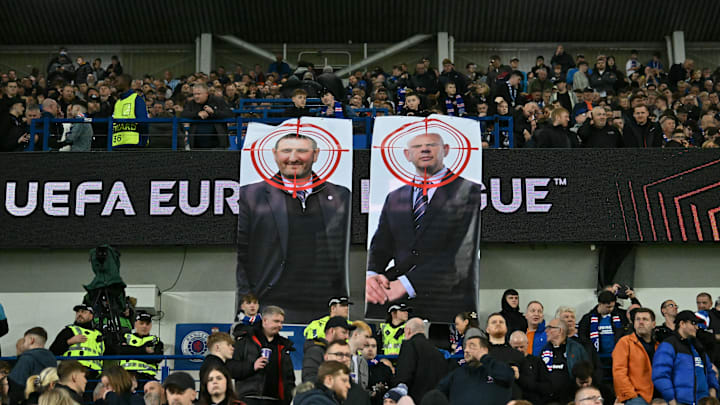
Wrath reared its head in the most symbolic way: the removal of banners targeting Patrick Stewart and Kevin Thelwell at the Rangers vs Roma UEFA Europa League fixture last week due to orders from above.
Instead of engaging with supporter frustration, the leadership attempted to suppress it. Anger met with anger. Critique met with control. Actions differing from their public words.
Sloth – Inaction when action was needed
Laziness, apathy, or the failure to do what must be done.
Sloth defined the moments between crises:
A failure to move quickly in replacing Martin.
A failure to streamline the squad.
A failure to modernise communication.
A failure to address obvious deficiencies from fitness to recruitment planning.
When decisive leadership was required, Rangers got hesitation, drift, and a reluctance to confront uncomfortable truths hoping that against all evidence it would get better.
Sloth allowed problems to deepen until they became impossible to ignore.
The seven deadly sins aren’t just moral warnings, they’re cautionary tales about the downfall of institutions blinded by ego, excess, and inaction.
For the new Rangers regime, the hope is that this early catalogue of sins becomes a lesson rather than a legacy.
Because unless pride gives way to humility, greed to prudence, and sloth to urgency, the club risks repeating the same cycles that have haunted it for more than a decade.
 Add us as a preferred source on Google