

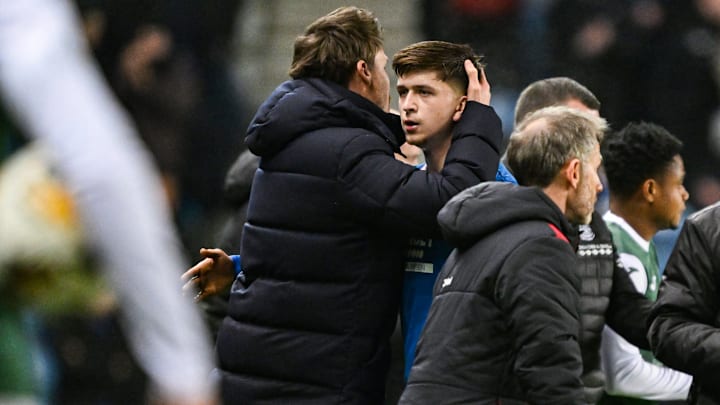
One of the most revealing aspects of Rangers win over Hibernian was not tactical shape or possession metrics, but the personnel Danny Röhl trusted - and what that said about the squad’s evolution.
Dujon Sterling’s first start since his Achilles injury was a significant decision.
After brief minutes in midweek, Röhl opted to throw him straight back into the starting XI.
“I’m very happy,” Röhl said of Sterling’s performance.
“He’s a defender. He has good interceptions. He feels where it’s dangerous.”
Sterling justified that faith with a composed display, capped by a crucial goal-line clearance that preserved Rangers’ lead and an assist for Emmanuel Fernandez’s winner.
Röhl revealed the decision had not been straightforward: “After the first minutes on Thursday he felt he was not playing for a long, long time. He was tired.
“Then it was the decision - do I bring him from the bench or start him?
“In the end I decided to start him.”
Sterling’s awareness and reading of danger were key to Rangers defensive solidity, particularly against Hibs channel runs and long balls.
“We played very solid in the last line,” Röhl said.
“There are a lot of channel balls where you have to take runners.”
Mikey Moore’s performance offered a different kind of encouragement.
Operating between the lines, Röhl identified him as a central figure in Rangers build-up.
“We spoke at half-time,” Röhl explained.
“He was the free man for me today.
“He can carry the ball, give us time to travel together.”
Moore’s bravery in possession stood out, especially when the crowd grew restless.
Yet Röhl also explained why the young midfielder was withdrawn despite playing well.
“You have to manage him,” he said.
“Otherwise you risk again an injury.”
That balance between trust and protection reflects Röhl’s wider approach to developing young players - belief without recklessness.
Röhl also acknowledged how youthful his side looked when he reviewed the team sheet.
“I was surprised when I looked at my line-up,” he admitted.
“It’s a young group. There may be not so many leaders.”
Rather than shielding them, Röhl challenged them.
He said: “This was a message from me - we have to grow up and we have to take responsibility.”
The response, while imperfect, was encouraging.
Players communicated, blocked shots and ran for each other.
Mistakes occurred, but the fundamentals were present.
“If you do the basics right,” Röhl said,
“then I feel we have quality in areas to win games.”
Sterling’s return, Moore’s growing influence and the collective willingness to shoulder responsibility all point to a squad learning how to cope with pressure - not by avoiding it, but by facing it head-on.
This will be crucial heading into Sunday's six-pointer at Tynecastle against table-topping Hearts.
 Add us as a preferred source on Google