

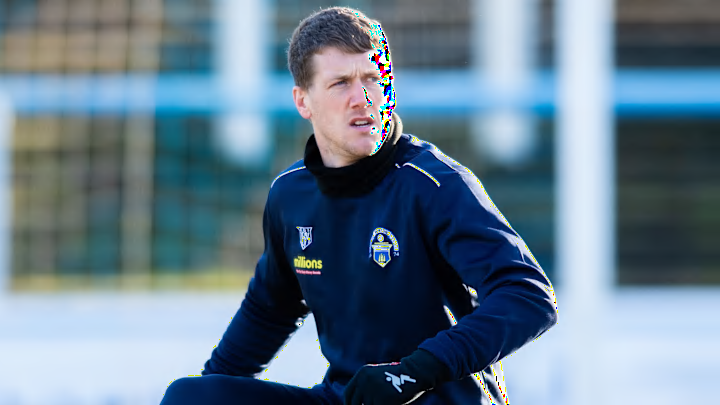
Former Rangers kit controller and current Scottish FA equipment manager Jim McAllister has offered a brutally honest assessment of this season’s managerial chaos across the Old Firm – and his words carry even more weight given the turbulent circumstances both clubs have endured.
McAllister, a former professional footballer with deep roots in Scottish football, took to LinkedIn to reflect on what he believes has gone wrong for Rangers and Celtic this season, pointing to an unwillingness to adapt as a key reason behind multiple managerial casualties.
McAllister was linked with a return to Rangers earlier this season before the plug was pulled by higher-ups after a press leak according to reports.
“I most certainly am not a coach, but watch lots of football,” former Morton defender McAllister wrote.
“I find it absolutely incredible what I've seen from both Rangers and Celtic managers this season.
“Both stubborn to change and adapt to the tools that they have and it cost them brilliant jobs.”
His comments arrive after a remarkable period of instability in Glasgow.
At Rangers, Russell Martin was dismissed in October after a disastrous start to the campaign, having recorded just one league win before losing the dressing room and the backing of supporters.
His commitment to a rigid tactical philosophy, despite an unbalanced squad, proved costly.
Celtic’s situation was even more chaotic.
Following Brendan Rodgers shock departure, the club briefly turned to Martin O’Neill in an interim capacity. The legendary former manager steadied the ship for around six weeks before the arrival of Wilfried Nancy, whose reign lasted just over a month.
Nancy’s spell was brutal: two wins, six defeats, culminating in a 3-1 home defeat to Rangers at Celtic Park and an increasingly fractured relationship with supporters.
He was swiftly removed, prompting Celtic to turn back to O’Neill once more, who is now overseeing the side until the end of the season.
McAllister believes these rapid dismissals reflect a deeper issue in modern football – the prioritisation of philosophy over results.
“By all means implement your style/philosophy but don't sacrifice results for it,” he wrote.
“Win games of football. There is more than one way to win a game so for me coaches should be extremely adaptable.”
For Rangers supporters, his most telling observation focused on the club’s current direction under Danny Rohl.
“Look at the manager that has went in at Rangers,” McAllister added.
“I am sure he has a way he would like his team to play, but he has parked that, utilised what he has got and produces results.”
Rather than forcing a rigid system onto an injury-hit squad, Röhl has prioritised structure, organisation and game management – a pragmatic shift that has helped stabilise performances and restore belief inside Ibrox.
McAllister believes that winning, above all else, is what buys a manager the time to truly implement their vision.
“Win games – it buys you time to implement what you want to implement,” he explained.
“Football is a simple game made complicated by coaches.”
The contrast between Rangers and Celtic is stark. While Rangers have found a degree of stability through adaptability, Celtic have lurched from one managerial experiment to another, with supporters left watching a revolving door of ideas, systems and philosophies to differing success while Hearts under experienced Scottish coach Derek McInnes’ remain top of the table.
McAllister’s comments also underline a wider lesson for modern coaches: tactical identity matters, but flexibility matters more.
Systems must fit players, not the other way around. Those who refuse to adjust risk alienating squads, fans – and ultimately, their employers.
In the unforgiving environment of the Old Firm, patience is a luxury few managers are afforded. Pressure is constant, expectations are relentless, and results are non-negotiable.
McAllister’s verdict is clear: in Glasgow, ideology will never outweigh winning.
And this season, both clubs have learned that lesson the hard way.
 Add us as a preferred source on Google