

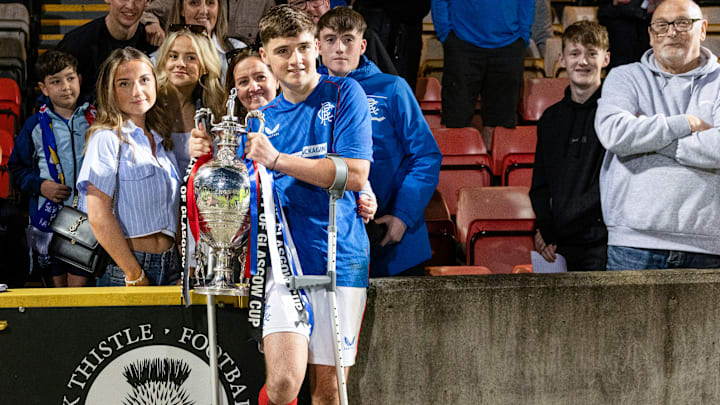
One of Scottish football’s oldest and most storied competitions will return this month, with Rangers set to take centre stage against two of their Glasgow rivals.
The City of Glasgow Cup, first contested in 1887, remains a symbol of the city’s fierce footballing heritage – and the Gers will once again look to add to their rich history in the tournament.
Originally competed for by the first teams of Rangers, Celtic, Clyde, Partick Thistle and Queen’s Park, the Glasgow Cup was a yearly fixture for over a century before fixture congestion brought its traditional format to an end in 1989.
What followed was a youth-focused version of the competition, before a modern revamp in 2019 saw a hybrid structure introduced. Since then, Thistle, Clyde and Queen’s Park have fielded their senior sides, while the Old Firm have competed using youth teams.
Across both senior and youth eras, Rangers remain the competition’s most successful club, lifting the trophy on 59 occasions.
Their most recent triumph came last season, when the Colts defeated Celtic on penalties at Firhill following a dramatic 1-1 draw. It was another reminder that, regardless of age group, the badge still carries expectations of success.
The Glasgow Cup also holds a special place in Rangers folklore. It was the setting for Graeme Souness’ first match in charge of the club in 1986, when Rangers defeated Celtic 3-2 in the final.
Ally McCoist’s famous hat-trick that day remains one of the tournament’s most iconic moments and marked the beginning of a new era at Ibrox.
This month, Rangers’ youth side will host Clyde and Partick Thistle at the club’s Training Centre as they begin their group-stage campaign. The opening fixture against Clyde, takes place on January 13, before the Jags visit on January 19.
While Clyde and Thistle are free to field as many first-team players as they wish, Rangers will be restricted to using just three overage players. That dynamic often makes the Glasgow Cup a valuable test for young Gers prospects, who must adapt to the physicality and experience of senior opposition.
So far, three group fixtures have already been played. Clyde edged Queen’s Park 1-0 in June, Queen’s Park defeated Thistle on penalties after a draw in October, and Celtic B overcame the Spiders in November. Rangers now enter the competition with a clear opportunity to assert themselves.
Further fixtures against Celtic and Queen’s Park are still to be arranged. Those matches carry added intrigue, with Queen’s Park’s youth side having already eliminated Rangers Under-19s from the Scottish Youth Cup earlier this season, while the young Gers have enjoyed success over Celtic in the CAS Elite League.
For Rangers, the Glasgow Cup represents more than just another youth tournament. It is a chance to uphold tradition, develop emerging talent, and maintain dominance in a competition deeply rooted in the club’s history. Retaining the trophy would reinforce the strength of the academy system and continue a legacy that stretches back well over a century.
Both upcoming matches will be played behind closed doors.
 Add us as a preferred source on Google