

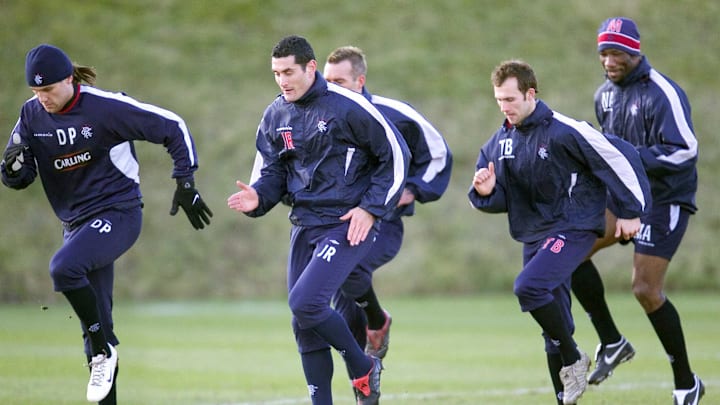
Former Rangers defender Marvin Andrews was never a conventional footballer – and a story shared this week by respected football agent John Viola has once again highlighted just how different his outlook on the game, and on life, really was.
Viola revealed how, during Andrews time at Raith Rovers in 2008, he helped secure a lucrative offer from English Premier League side Reading worth around £10,000 per week – a life-changing sum compared to the £500 Andrews was earning at the time.
Yet, to Viola’s surprise, the Trinidad and Tobago international turned it down.
“I told him about the club. I told him about the money,” Viola explained.
“There was a pause. Then he said, very calmly, ‘John, I’m happy where I am.’”
The reason wasn’t football related. Andrews was training to become a pastor, loved his home life, and felt content at Raith.
For Viola, the moment reshaped his understanding of what success means for different players.
“Not every player wants more money. Some just want to be happy,” he reflected.
“Football is a people business. And not every person sees having a lot of money as being rich.”
For Rangers supporters, the story feels entirely in keeping with the man who became a cult hero at Ibrox in the mid-2000s – a player driven by faith, belief, and an unshakeable sense of purpose.
Before his Rangers chapter, Andrews had already built a reputation as a fan favourite at Livingston, where he made over 120 appearances and helped the club achieve a remarkable third-place finish in the SPL after promotion in 2001/02.
His performances against Scotland’s biggest clubs caught attention, and Almondvale quickly became a place of emotional significance for him.
“One of the most emotional games in my life was when I left Livi,” Andrews once said to Nutmeg magazine.
“The fans stayed behind to say goodbye. I was crying. Some of the greatest days in my career were at that club.”
Financial problems at Livingston eventually forced key players to move on, and Andrews was offered a lucrative deal at Dundee United. Yet once again, faith guided his decision.
“I prayed and asked God if he wanted me to go to Dundee United and God said ‘no’,” he explained.
The story made headlines, and a few weeks later Livingston reached a League Cup final against Hibs. Soon after, Rangers came calling.
In the summer of 2004, Andrews arrived at Murray Park, stepping into a world far removed from the modest facilities he had known before.
“My eyes were opened,” he admitted.
“I was used to training on local parks with Raith and Livi.”
The step up was demanding. A misplaced pass in his first training session earned a blunt reminder from manager Alex McLeish:
“You’re not at Livingston anymore, Marv.” But Andrews responded the only way he knew how – with hard work, belief, and commitment.
Those qualities quickly won over the Rangers support. Andrews became a regular in the back line and a key part of the squad that would go on to deliver one of the most dramatic title wins in Scottish football history in season 2004/05.
“Helicopter Sunday was an unbelievable day,” he said.
“I still have to pinch myself when I think about that day.”
Yet Andrews’ most famous Rangers chapter wasn’t defined by trophies alone – it was shaped by his extraordinary response to injury.
In March 2005, he suffered a cruciate ligament problem that doctors believed required surgery. Andrews refused, insisting that God would heal him.
After weeks of training alone and signing disclaimers to protect the club, McLeish made the bold call to throw him into an Old Firm match against Celtic.
“I was nervous,” Andrews admitted.
“I hadn’t played for six weeks. But I played about 80 minutes and I played well.”
Rangers lost that day, but Andrews message to the fans and media became legendary: “Keep believing, God says it’s not over.”
What followed was one of the most astonishing title comebacks in Scottish football history, culminating in Rangers snatching the championship on the final day at Easter Road.
Andrews Rangers career came to an end under Paul Le Guen in 2006/07, but his story was far from over – and he continued to play in the Scottish and English lower leagues until 2016 – when he retired after a spell playing under ex-Rangers captain Barry Ferguson at Clyde at the age of 40.
Internationally, Andrews played a key role in taking Trinidad and Tobago to their first-ever World Cup in 2006. The emotional highs were matched by cruel misfortune when he injured his knee in training before the tournament began.
“I cried like a baby that night,” he recalled of qualification.
“Just to be there was a blessing for me.”
That sense of perspective mirrors the values highlighted in Viola’s recent story. While many players chase contracts and prestige, Andrews consistently chose a different path.
“I have a huge amount of respect for Marvin,” Viola wrote. “He is an amazing human being.”
For Rangers fans, Marvin Andrews remains a symbol of belief, resilience, and authenticity – a player who gave everything on the pitch, stayed true to his convictions off it, and left behind one of the most unique legacies in the club’s modern history.
As Andrews himself once put it: “With belief, you can do anything. If it wasn’t for God, the world wouldn’t know Marvin Andrews.”
 Add us as a preferred source on Google