

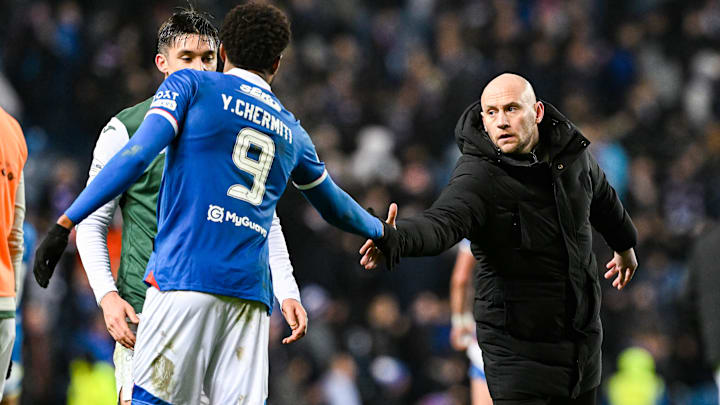
Hibernian head coach David Gray left Ibrox frustrated but defiant after his side’s narrow defeat, insisting Rangers did not outplay his team and that the outcome was decided by moments rather than control.
Gray’s assessment cut against the narrative of a routine home victory.
While Danny Röhl’s side secured three crucial points, the Hibs boss felt his players executed the game plan he asked for – particularly in the first half.
“I asked the players to be brave, be aggressive, get after Rangers and go toe-to-toe,” Gray said.
“I thought they did.”
From the opening exchanges, Hibs pressed high and looked to disrupt Rangers build-up, forcing turnovers in wide and central areas.
Gray believed his side had a foothold in the contest early on.
“I thought they won the ball back well in good areas and had a lot of control in the first half,” he added.
However, Gray was blunt about where the game slipped away.
Despite promising positions, Hibs failed to make their possession count.
“For all the control I felt we had, we didn’t really have a cutting edge,” he admitted.
“It wasn’t for getting into good areas – it was the final bit.”
That lack of incision ultimately allowed Rangers to stay in the game and eventually get the breakthrough from an Emmanuel Fernandez header.
A set-piece goal gave the home side momentum and ignited the Ibrox crowd – something Gray knows can quickly change the dynamic of a match.
“We lose a goal from a set-piece, and that gave Rangers a five-minute period where they got on top,” he said.
“The crowd got behind them – which happens here, we know that.”
Gray acknowledged that Rangers emerged with greater aggression after the interval but maintained that the contest remained finely balanced.
“In the second half I thought Rangers started more aggressive, and we didn’t really have the solutions to that,” he said.
Even so, Gray resisted any suggestion that Rangers were superior across the 90 minutes.
“Nothing to do with being outplayed,” he insisted.
“More than toe-to-toe for large periods, especially the first half.”
From a Rangers perspective, the comments underline a growing theme under Röhl.
This was not a performance built on dominance or fluency, but on organisation, resilience and taking advantage of decisive moments.
Gray’s admission that his side failed to force Jack Butland into meaningful action further highlights that defensive solidity.
“We didn’t really force Butland into enough saves,” he conceded.
While Gray’s frustration centred on his own team’s shortcomings, his words also reflected an understanding of how Rangers can manage games at Ibrox.
They may not always control possession, but they remain capable of riding pressure, drawing energy from the stands and punishing lapses – something they were incapable of earlier in the campaign under Russell Martin.
 Add us as a preferred source on Google