

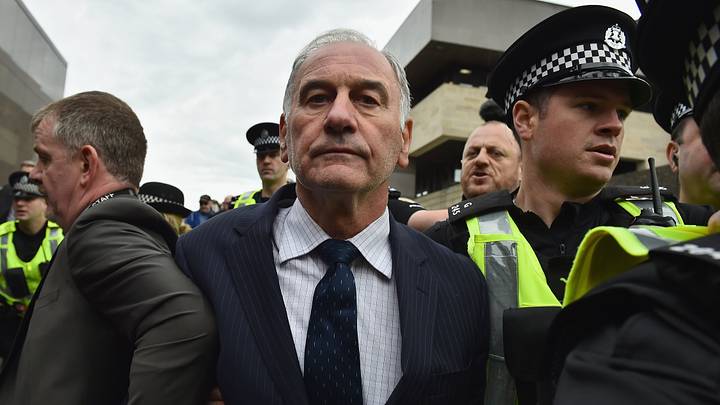
Charles Green has once again opened up on his controversial spell at Rangers, insisting he “never tells lies” while claiming the club could have been playing in the English football pyramid had he followed through with an alternative plan.
The former Rangers chief executive was speaking to Andy Gray and Richard Keys when he revisited the extraordinary events surrounding the club's financial collapse in 2012.
Green remains a hugely divisive figure among Rangers supporters, with many fans holding the former chief executive responsible for a turbulent period in the club's history, even post-financial collapse under Craig Whyte, and strongly disputing aspects of his version of events.
Indeed, Green's reputation among the Ibrox support remains so poor that his appearance on the interview prompted an immediate acknowledgement of the issue before he even joined the conversation.
“I never, never, contrary to what Rangers fans, never tell lies,” he said. “OK, never.”
That claim sets the tone for an interview in which Green repeatedly presented his own interpretation of events surrounding Rangers' collapse, the battle with HMRC and the eventual formation of the new company.
Green insisted he had been dragged into football rather than actively seeking another club ownership opportunity.
He said he initially had no plans to become involved with Rangers but was encouraged to make an offer after watching the crisis unfold.
“This wasn't my dream ticket,” Green said. “I had no plans to go back into the football world, because I've always known it's completely mad.”
He ultimately purchased the assets of Rangers for £5.5 million but claimed the situation he inherited was considerably more complicated than many supporters understood.
According to Green, he was initially attempting to secure a creditors' voluntary arrangement that would have allowed Rangers to retain their place in the top flight.
He claimed the club had been told HMRC was prepared to support the arrangement before ultimately rejecting it.
“Now either Deloitte [technology] are lying, which I don't believe they are, or HMRC were lying,” Green said.
“Someone there definitely was because we were being told that HMRC would support.”
The decision meant Rangers were no longer a going concern and, according to Green, the new company was left without a licence to play football.
It was during this period that Green claims he began considering an extraordinary alternative.

Green wanted Rangers in England
Green revealed he explored the possibility of purchasing Stafford Rangers and effectively transforming the club into an English-based Rangers side.
“Because if I buy Stafford Rangers, I change the name a day after I bought it,” he said.
“It's no longer Stafford Rangers. We delete the name Stafford and we become Rangers.
“We now got a team which is, you know, this guy, that guy, that guy, this guy, who are obviously the Rangers' first team.
“In Scotland, we have the reserves playing in the Scottish League.
“We've got Welsh teams playing in England. We've got Scottish teams playing in England. We've got English teams playing in Scotland.
“But all of a sudden, just because Charles Green wants to do it, it's not allowed.”
The claim will undoubtedly be one of the most eye-catching parts of the interview for Rangers supporters, although Green's suggestion that the club could realistically have established itself in the English pyramid remains his account of what might have happened.
He went further, suggesting that Rangers and Celtic should ultimately have been playing in the English Premier League.
“If it was sensible, you'd have Rangers and Celtic playing in the English Premier League tomorrow,” Green said.

The Ibrox demolition claim
Perhaps even more extraordinary was Green's recollection of how he responded when officials questioned whether he had the authority to make major decisions about Rangers.
He claimed he reminded them that he had paid millions for the club's assets and owned the Rangers Training Centre and Ibrox.
“I bought it for 5.5 million. How much money can I lose?” Green recalled saying. “I own Murray Park. I own the stadium.”
“I can close it down. I can scrap it or I can go for planning on the listed building at the front after we've demolished the stadium.”
He even joked about selling the seats to supporters and cutting up pieces of the pitch.
Green claimed the comments were designed to demonstrate that he had the financial and legal authority to make decisions that officials appeared to doubt he could make without consulting his investors.
He said a subsequent meeting with one of his shareholders lasted only around two minutes before his authority was confirmed.

A controversial Rangers legacy
Whatever view supporters take of Green, his latest interview will do little to settle the arguments surrounding his time at Ibrox.
The former chief executive remains one of the most controversial figures in modern Rangers history, with supporters divided over his role in the aftermath of the club's collapse.
Green, however, remains adamant that he was unfairly portrayed.
At one point during the interview, he claimed the period was filled with “lies and deceit” and argued that he was the person who remained truthful throughout.
That is a particularly striking assertion given the long-running distrust between Green and most of the Rangers support.
Green argued that the hostility towards him stemmed partly from the circumstances in which he arrived.
He pointed to the constant media coverage following Whyte's announcement that Rangers had entered administration and suggested supporters were bombarded with competing claims about who would save the club.
He said he was subsequently encouraged to become involved before eventually emerging as the successful bidder.
Green also recalled the hostility surrounding Rangers' expulsion from the top flight and described a meeting where clubs were deciding the club's future.
His account included a remarkable exchange in which he claimed one club told him supporters were threatening a season-ticket boycott if they voted to keep Rangers in the league. Green said he responded by taking out his chequebook.
“I'll have all the season tickets you can vote for in favour of us,” he recalled telling the club.
Whether Green's recollections change the way Rangers supporters view his role in the club's most traumatic modern chapter is another matter.
His latest comments certainly provide plenty of ammunition for debate, from the extraordinary claim that Rangers could have pursued an English football future to his insistence that he was prepared to dismantle Ibrox rather than surrender control.
But almost 15 years after Rangers' financial collapse, Green's version of events remains exactly that: his version.
For a Rangers support which has long been deeply sceptical of the former chief executive, his insistence that he “never tells lies” is unlikely to be the final word on one of the most controversial periods in the club's history.
 Add us as a preferred source on Google